English
 Fr
Fr العربية
 BI
BI 中文
中文 РФ
РФThe Primary Reasons to Build or Customize Your Own AI Model
Why off-the-shelf AI falls short — and how building your own unlocks proprietary data, privacy, speed, cost savings, and unmatched precision for your unique workflows.
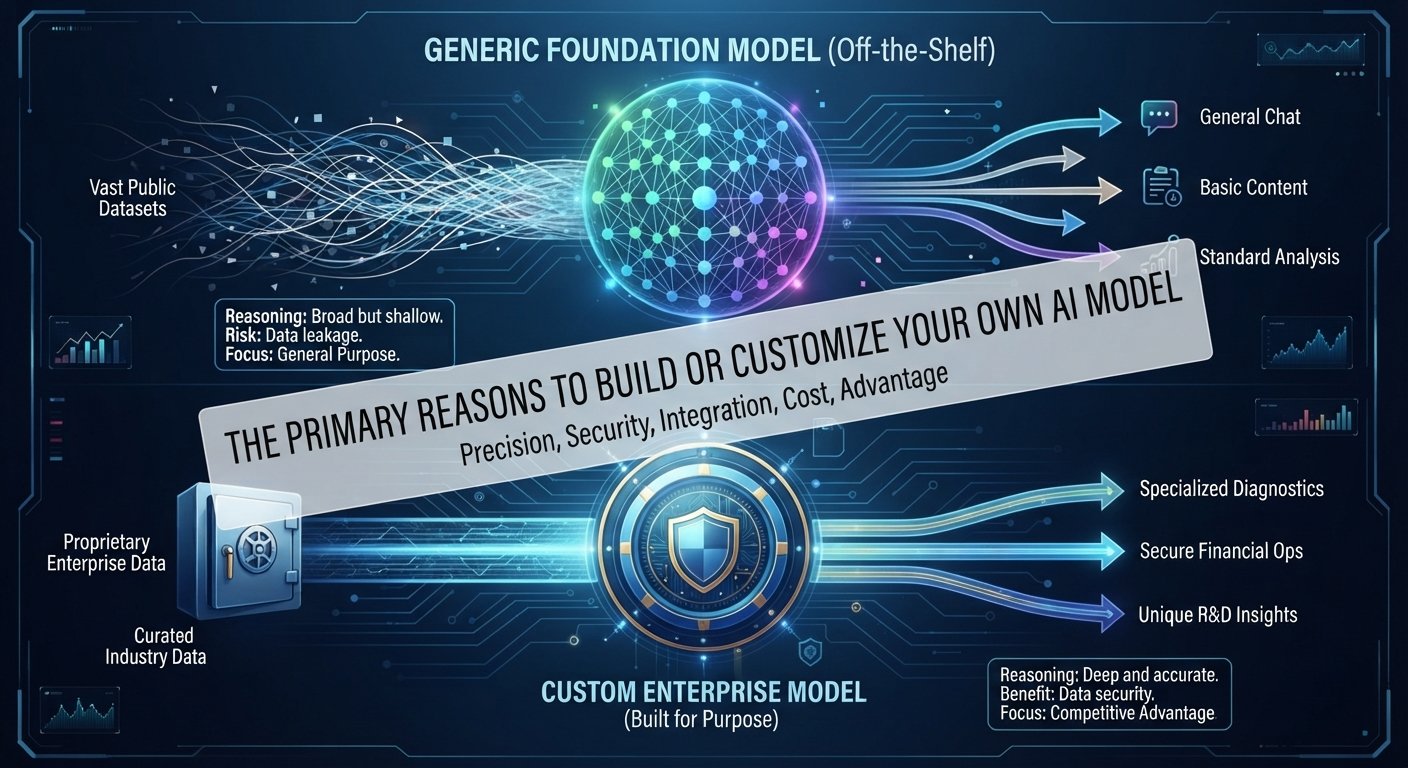
General-purpose AI models are trained on public data, making them powerful but blind to your company’s internal products, confidential processes, or specialized industry language. Building or fine-tuning your own model transforms AI from a generic tool into a competitive advantage tailored precisely to your business.
Whether you’re in manufacturing, healthcare, finance, or defense, a custom model ensures your AI understands your specific standards, protects your sensitive data, runs instantly at the edge, and scales cost-effectively — all while delivering pinpoint accuracy that general models simply cannot match.
1. Proprietary Data and Domain Expertise
Off-the-shelf models are trained on public data, meaning they lack knowledge of your company’s internal products, confidential processes, or specific industry jargon.
Example: A general computer vision model knows what a “scratch” looks like in a generic photo, but it won’t know the precise, micro-defects unique to the specific medical devices or circuit boards your factory manufactures. Building a model lets it learn your specific standards.
2. Data Privacy, Security, and Compliance
Using public cloud APIs means sending your sensitive corporate data, customer records, or proprietary designs to a third-party server.
Many industries (healthcare, finance, defense, manufacturing) face strict regulatory requirements (like HIPAA, GDPR, or trade secrets protection). Building or self-hosting a model ensures your data never leaves your secure infrastructure.
3. Edge Deployment and Latency
Many real-world use cases require instant decision-making where internet connectivity is slow, unreliable, or unavailable.
Example: An automated robotic arm on an assembly line cannot wait a second for a round-trip to a cloud-based LLM to decide whether a part is defective. It needs a lightweight, custom model running locally on an edge device (like a local GPU or microchip) with zero latency.
4. Cost Efficiency at Scale
Relying on commercial API calls for millions of daily transactions can become prohibitively expensive.
While training a model from scratch is costly, fine-tuning an open-source model or training a smaller, task-specific model requires far less computing power. Once built, running it locally or on dedicated infrastructure often costs a fraction of continuous API usage.
5. Task-Specific Precision and Accuracy
General models are jacks-of-all-trades and often suffer from “hallucinations” or lack the pinpoint accuracy required for specialized workflows. A custom model optimized for a single, narrow task will consistently outperform a broad model, drastically reducing error rates in critical operations.
Building your own AI model isn’t just about technology — it’s about owning your intellectual property, protecting your data, and delivering superior results that off-the-shelf solutions can’t achieve.
EdgeOfContent helps you assess your use case, choose the right architecture, and build custom AI models that fit your budget, data, and performance requirements — from fine-tuning open-source LLMs to training lightweight edge models.
Get More Insights